Showing posts with label gardens. Show all posts

Thursday, August 28, 2014

Villa Hanbury in the Afternoon


Built on the site of an ancient Roman villa, 48 acres encompass the whole of Capo Mortola, a half mile into Italy from the French border on the Mediterranean.  The land and palazzo were purchased in 1867 by Sir Thomas Hanbury after he made his fortune in China.  With his botanist/pharmacist brother Daniel and head gardener Ludwig Winter along with, later, his son Cecil and daughter-in-law Dorothy they built a fabulous botanic garden.


La Mortola


What made it fabulous was the improbability of building an Eden on such a dry slope.

(Seen from above)  "It is as if the garden has been folded into a fissure in the rock...the effects of water on limestone may have worn away a cosy niche for the palazzo, but the soil it has created is heavy, clay-like and not suited to many plants, which prefer a more acidic medium.  It is a burnt-cream colour and, once dry, it cracks like subsiding plaster.  In the summer the soil sets hard, clamping plants in its rocky grip, while rain or irrigation runs slickly off its surface.  Any moisture absorbed drains quickly from the sloping ground." (La Mortola: in the Footsteps of Thomas Hanbury by Alasdair Moore)
Carved out of a steep slope rising 103 metres from the Mediterranean it was not the easiest site to garden.  Terraced gardening is not for the faint of heart or weak of muscle. Still standing are the ancient retaining walls, esplanades and old brickwork boundary which separates the Roman villa from the sea.  But it's  a never-ending process and impossibly hard work.  The regional geography, however, works in the botanist's favor by providing the mildest climate north of Egypt and water, though scarce, springs from the snows of the nearby Ligurian Alps.  Tropical plants abound here, in fact this garden is the source of the Riviera's early fascination with palm trees.
"What Sir Thomas Hanbury had started, with more ambitious and scientific objectives, in his botanical garden at La Mortola, was reproduced - out of emulation, as a mark of prestige, or for aesthetical reasons - practically everywhere in the gardens along the western riviera."  (From the current Unesco list of tentative sites.  Villa Hanbury was nominated for Unesco status in January, 2006, along with Orvieto, and the historic centres of Lucca and Parma.) 

Hanbury was the classic Victorian amateur botanist, collecting plants from all over and introducing them to his garden.  To propagate them (a Victorian obsession with the secrets of reproduction crops up often in accounts from this time) often required patience and creativity when the native propagators from Africa, Asia and/or South America weren't available. Australian plants, especially eucalyptus, were one answer to this harsh environment.  And eucalyptus had "febrifugal" qualities, good for counteracting the scourge of malaria.  This garden was to be a living laboratory, completely out of doors, where pharmaceutical plants from around the globe could be propagated and studied for future medical availability.  Drought-tolerant succulents like the agaves and aloes form the backbone of much of the garden and are historically critical components of Central and South American pharma-culture.

I learned a lot about gardens the afternoon I spent this April at Villa Hanbury. Much like the townscape in a city, they can be broken into basic elements, some of which I include here as they suggested themselves to me through my photographs from that afternoon in April.


Prospect and View


The Mediterranean Sea provides a view of Corsica on clear days.


The gardens were ruined in World War 2.  Fully half of the existing garden is native vegetation.  It is now in the care of  Universita degli Studi di Genova Centro di servizio di Ateneo per i Giardini Botanici Hanbury, donated by the Hanbury family.


Paths

Arguably the most important element in a difficult environment, they're all laid out according to the original Roman road, the Via Julia Augusta.  A road Dante, it is said, once strode upon.


Shaded pathways are welcome in the hot sun


Evergreens also provide protection from marine winds


Monuments


Wisteria in April outside the Palazzo Orengo
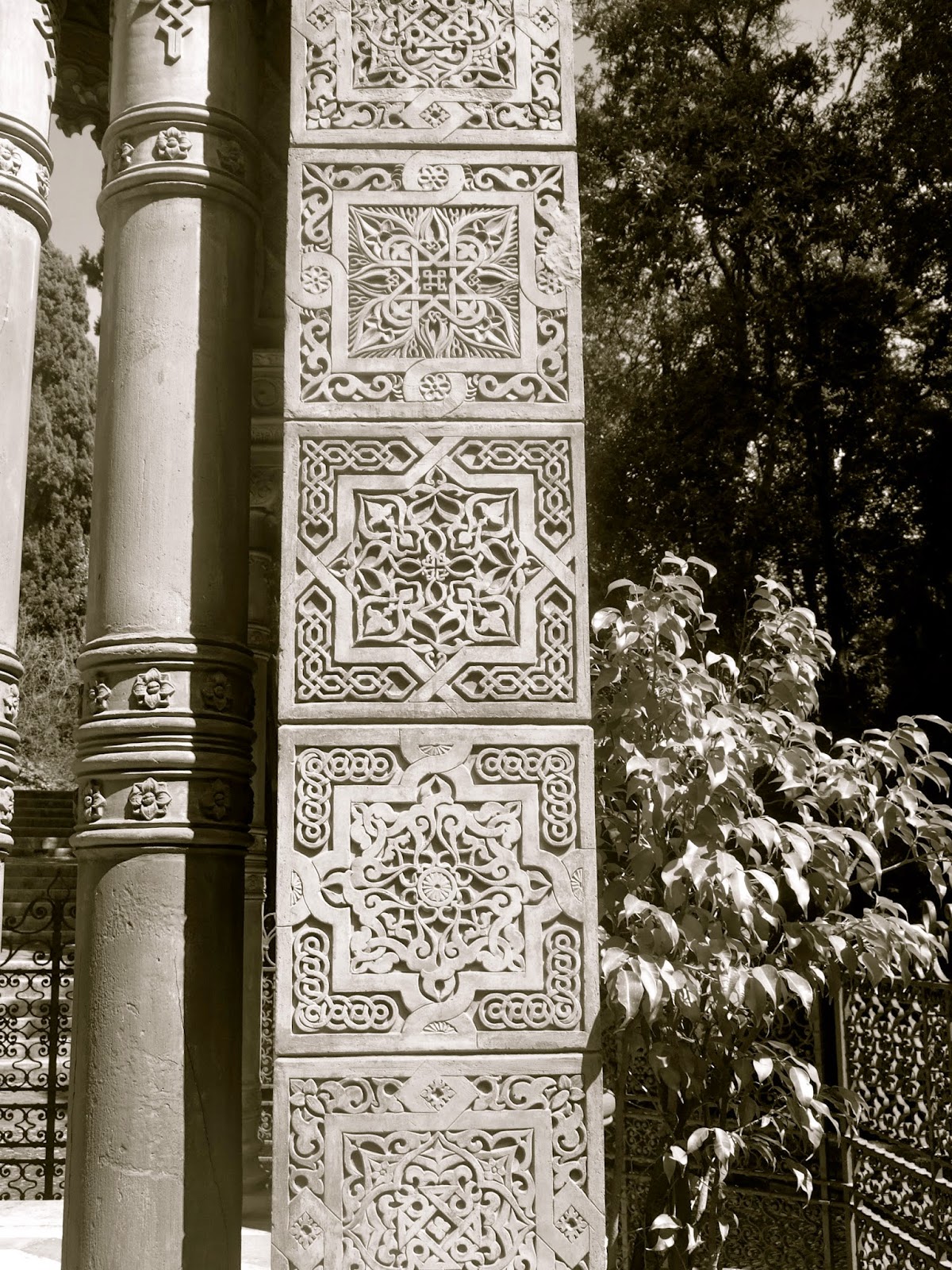
Imbedded in the walls around the Palazzo are bas reliefs, shown below, adding to the Garden's mystery and uncertain age, its elements appear to have accreted over time.


The Moorish Kiosk, planned and built in 1886 by San Remo architect Pio Soli.  Here lie the ashes of Thomas Hanbury and his wife Katharine Pease.


Mosaic of Marco Polo, designed in 1888 by Salviati

The Tempietto


Water


Dragon Fountain with papyrus, traditionally grown for paper-making in Egypt.


Collections and Specimens

This is what Villa Hanbury is really known for.  There are 5800 species in Hortus Mortolensis.  
Daniel Hanbury, Thomas' brother, planted a Casimiroa edulis in 1867, the first year of planting the garden.  It came from the Central American plateau and was "highly esteemed by the early settlers because of its edible fruit and the hypnotic properties of the flour obtained from the fruits....In the early years Thomas left his eldest brother Daniel to continue the development of the garden while he was engaged in his business activities.  In this period many plants that were not only decorative but also of pharmaceutical and economic interest were introduced."  (Hanbury Botanic Gardens brochure)
Brugmansia by the original Roman Road.  Brugmansias from South America were used for therapeutic and psychedelic purposes during religious ceremonies.  Their flowers, in the form of a trumpet or a bell, give off a delicate smell that attracts a moth which is native to Europe--bypassing the need for the South American hummingbird, the traditional pollinator of the plant.

The agave flower, a common site throughout the Riviera.    Only once in their lives do they flower, producing a flowering stem that can achieve heights of 12 metres.

Agave is the source of tequila, originally called pulque, which played an important role in the Aztecs' culture, fuelling many of their religious ceremonies.


Aloes, useful for wounds and digestion.


In the early years the Ligurians who lived in the surrounding area were mistrustful of foreigners who planted ornamental gardens and weren't inclined to maintain gardens as fiercely productive as those of the natives.  However, the Hanburys fostered ancient citrus orchards which produced pummelo, lumia, citron, Mauritius papeda, bergamot, bitter orange, sweet orange, lemon, grapefruit, mandarin, tangerine and kumquat as well as the quince, the loquat, raisin tree, avocado, feijoa, mountain paw-paw, guava, macadamia.  In addition there are local fruit trees including the service tree, the azarole, the jujube, the medlar and the pistachio.

Also in the collection are outstanding cycads whose origin is very ancient, existing during the Mesozoic Era (between 200 and 100 million years ago)


Repose and Accommodation

Sojourners have walked the important Via Julia Augusta for centuries.  Archaeological finds are accomodated and given a home in the garden.

Frequent places to rest are provided to visitors unused to the strenuous hill climbing required.
Snack bar in the former laundry at the base of the hill
One of many opportunities to rest and reflect

Color


Wednesday, May 28, 2014

Gardens: Nature vs. Nurture

It's so difficult to tell the real from the unreal, what's for sale, what's for free, what's "natural" and what's artifice, and cultivation, lately.  You can enjoy both a park and a nursery for free.  Is one "real" nature, and the other, "fake?"  At the moment, my mother gets more enjoyment from the "fake" because the "real" waterfall is too hard for her to get to.

Coal Creek Falls, Bellevue, WA
Down to Earth Nursery, Eugene, OR


Here is a sculpture by Julie Spiedel in the City Hall gardens, downtown Bellevue, WA:


It's my favorite sculpture in the City, and I was reminded of it on a recent visit to my favorite plant nursery:


Wells Medina Nursery, Bellevue, WA

Perhaps there is no "real', no "fake".  Perhaps it is all just a matter of art or advertising, as in a game we used to play with the kids...we would drive past something and ask, "Is it art or is it advertising?"  I know it came from my father's wife, Elizabeth, herself an artist of nature.  Click here to see more of her work on her website.

Sea of Tranquility


Ancient Light


Beth's work is haunting, painstaking and extremely beautiful.  Well-worthy of comtemplation.  In fact, I would love to do several blog entries just about her.  But...another day.

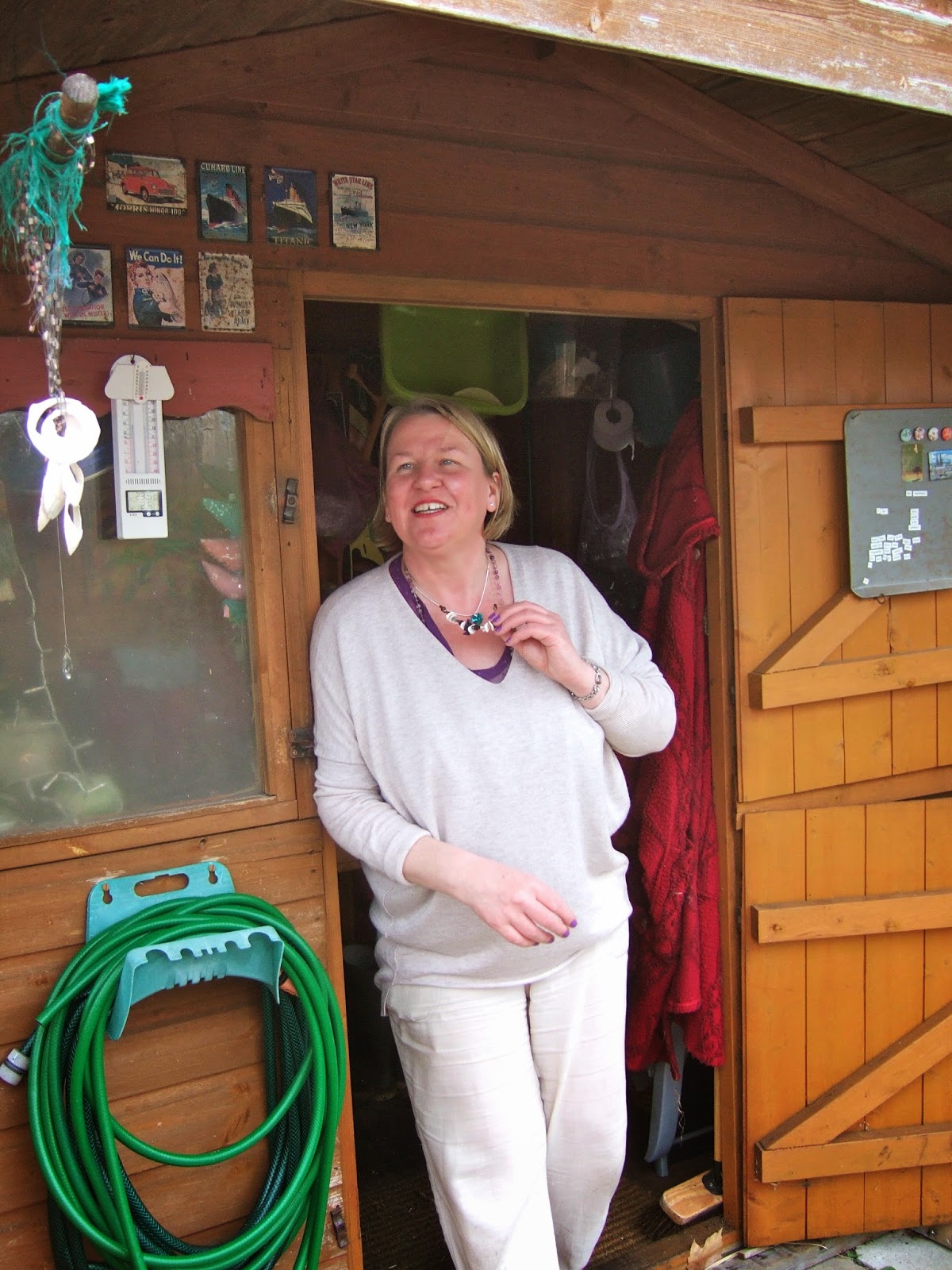
I really wanted to talk about my newly-found friend again, Sarah Horton, and her allotment garden in Liverpool, England.  Allotments are like p-patch gardens, which I've written about in these pages.  On the other hand they're very different.  For now, I just want you to enjoy a visit to Sarah's garden, and save the politics and history for another time.  Sarah, a fiber artist, film-maker, writer and certified horticulturist (in addition to many other things) incorporates who she is into her garden.  This is truly gardening for the soul.  Thank you, Sarah, for sharing it with me.


Sarah in her poly-tunnel

Sarah starting a fire with her flint


Inside her garden shed, complete with...

Fairy lights that really work


Sarah's Garden:  "Arrangement 1"


Sarah's Garden: "Arrangement 2"


Sarah's Garden:  "Arrangement 3"


Sarah's Garden:  "Arrangement 4"


Sarah's Garden: " Arrangement 5 (Masks)"

Sarah's Garden:  "Arrangement 6 (Oners)"


Sarah's Garden: "Arrangement 7  (Succulents)"


When I returned from my travels a month ago, I headed over to my father's garden in Indianola.  What a difference to Sarah's!  And yet, I kept finding similarities, as well.  For one thing, the focus is on contemplation, not production per se.  There are collections, arrangements, accomodations.  Dad built his house here with great respect for the existing land and flora.  Gradually, over many years, he has found his way to gardening with nature.
Dad's Garden:  "Arrangement 1"


Dad's Garden:  "Arrangement 2"


Dad's Garden:  "Arrangement 3 (Mondo and Mara)"


Dad's Garden:  "Arrangement 4 (Chairs)"
Dad's Garden:  "Arrangement 5 (Path 1)"

Dad's Garden: "Arrangement 5 (Path 2)"


Dad's Garden:  "Arrangement 6 (Ferns)"


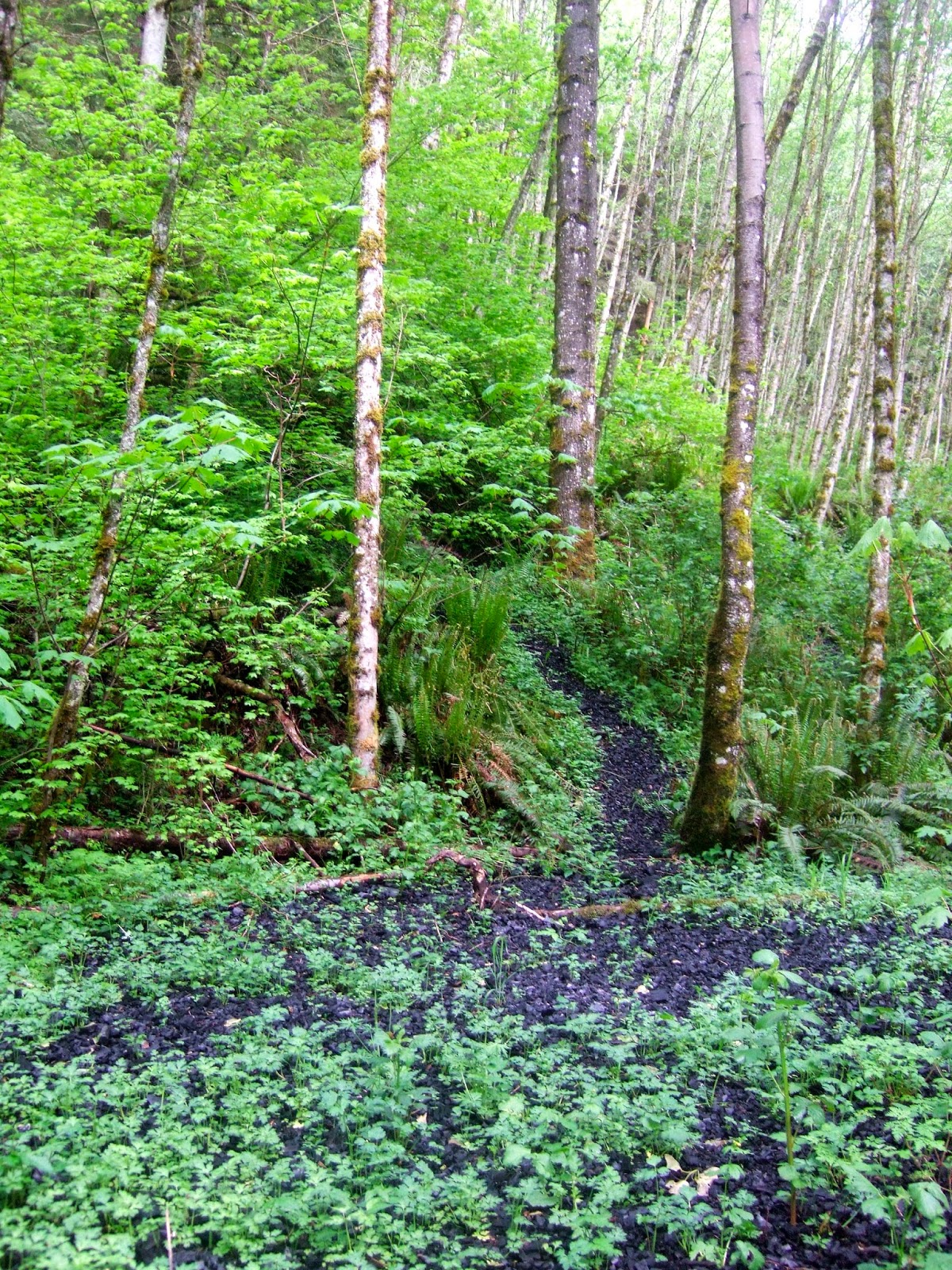
The day after visiting my father, I walked my dog up to Coal Creek Falls.  It is here that I've done all my most productive thinking and peaceful meditation for the last 20 years.  For the first time, I'm asked to contemplate something.   A rope fence, which Stella cheerfully ignores, separates a patch of ground from the trail.

Things are not as "real" here as I thought.  

 It turns out that this is an art installation highlighting Cougar Mountain's history of extracting natural resources.   The artist is from Basel, his name is Hans Baumann, and the work of art is called "Black Forest (29,930,00 Tons)".  It uses "bio-char"and asks us to envision the ash planted on the site as a proposal for carbon sequestration. Over time, they are asking that 29,930,000 tons of CO2 be sequestered here.  This is the amount emitted over the 100 years of mining on this site.    


Hans Baumann installation at Cougar Mountain here
and here
Cougar Mountain Regional Wildland Area, Bellevue, WA
On Tumblr

Hans Baumann installing "Black Forest"